Showing posts with label Tomo. Show all posts

Saturday, March 12, 2022

Tomo Anthology 10th Anniversary! Words from Contributors

Believe it or not, the Tomo Anthology has turned 10!
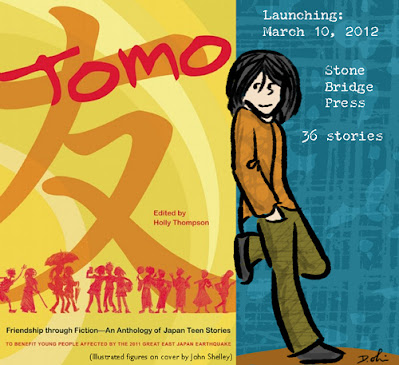
Launch card with Tomo cover with silhouettes by John Shelley and side illustration by Debbie Ridpath Ohi

In the first few weeks after the March 11, 2011 Great East Japan Earthquake and Tsunami, so many writers, illustrators and translators living in or connected to Japan wondered what they could do to help the tsunami- and nuclear disaster-ravaged communities of Tohoku in meaningful ways. I was just one of those individuals. And within a month of the tsunami I'd made two commitments that shifted my way of being in this world. 

One commitment was to join volunteer teams in cleanup efforts in Ishinomaki City in Miyagi Prefecture, which resulted in resets of my appreciation of disaster aid, community and the importance of being fully present in our daily lives and in interactions with others. 

The second commitment was to create an anthology of short fiction that would help support teens in Tohoku in the challenging years ahead. And thanks to the heroic efforts of so many talented and dedicated individuals, this commitment resulted in the Tomo Anthology: Friendship Through Fiction--An Anthology of Japan Teen Fiction published by Stone Bridge Press in March 2012. 

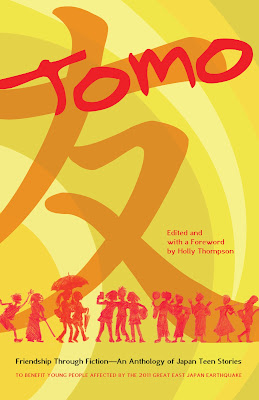
Compiling this anthology was a breathless volunteer sprint--36 stories to select, edit, finalize; over 40 contracts to be signed; cover design and illustrations to be finalized; reader's guide to be created; blog site to be built; interviews with contributors to be done; publicity plans to be made. The Tomo Anthology was completed on time thanks to the diligence of the more than forty contributing writers and translators; the generosity and patience of Stone Bridge Press publisher Peter Goodman; the hard work of the Stone Bridge Press editorial, design and publicity team; the intricate cover illustrations (can you match each silhouette to its story?) created by John Shelley; and all the other individuals working in the background to enable this anthology to be imagined, compiled, edited, printed and published in under one year.

While the Tomo Anthology is no longer in print, the Kindle E-book lives on--perfect for middle school and high school libraries and classrooms, reading groups, and gifts to friends. We hope you'll continue to support Tomo. All proceeds from the Tomo Anthology go to programs that support teens in 3/11 impacted Tohoku areas. 

Yesterday marked the eleventh anniversary of the Tohoku triple disaster, and people of the three hardest hit prefectures of Iwate, Miyagi and Fukushima and throughout Japan paused for a moment of silence at 2:46 p.m. We will not forget. 

Below, for this tenth anniversary of this anthology, we'd like to share some words from the publisher, editor, and some of the many creative contributors to Tomo: Friendship Through Fiction.

             Holly Thompson, Editor   


Peter Goodman, Publisher, Stone Bridge Press: As publisher of the Tomo anthology I am grateful to all the writers and translators and especially to Holly Thompson for entrusting us with the important mission of helping to create a bond among young adult readers in Japan and around the world. People who understand each other are inclined to help each other, and I’m sure the Tomo spirit will endure as many Japanese now step up to provide relief and compassion to others in distant lands.

Holly Thompson, Editor; author of foreword:  Growing this Tomo anthology with all the contributors and Stone Bridge Press has led to lasting friendships, and visits up and down the Tohoku coast. I continue to learn from those I meet in Tohoku--survivors, returnees, volunteers who stayed, newcomers and visitors. My hope is that Tomo will continue to encourage readers of all ages to take their own steps to support communities in need--those nearby, as well as those more distant.

Fumio Takano (高野史緒), author of "Anton and Kiyohime":  Over the past decade, not a day has gone by when I have not thought back on everyone's friendship. Not just the donations the book has generated, but the friendships, too, have been a real source of moral support. Thank you! I love you! 

Hart Larrabee, translator of "Anton and Kiyohime":  In summer 2012, I attended a translation workshop where participants, working with author Hideo Furukawa, collaboratively translated excerpts of his book about returning to his native Tohoku after 3/11. Regarding our rendering of one passage, he challenged us to “convey the essence of a tsunami through a sudden textual assault that leaves an uncanny tranquility in its wake.” The workshop changed the way I think about writing, and about the physicality of language. The essay I wrote about the workshop, the book, and 3/11 for the Society of Writers, Editors, and Translators can be found here on the SWET website.

Katrina Goldsaito, author of "I Hate Harajuku Girls": In these ten years since beloved Tomo, I’ve kept working with the subject of grief: publishing The Sound of Silence, set in Japan, which Maria Popova called "a serenade to the art of listening to your inner voice amid the noise of modern life"; a new book from Little, Brown on the Japanese concept of mono-no-aware; and our new global art experience ReachYou which offers mindfulness in grief. Happy 10th Anniversary, Tomo! What a project to be a part of.

Avery Fischer Udagawa, translator of "House of Trust" by Sachiko Kashiwaba:  Since “House of Trust” appeared in Tomo, Iwate-born and -based author Sachiko Kashiwaba has continued to write spellbinding fiction for children and young adults, often with a touch of folklore, magic, or both. I had the honor of translating her novel Temple Alley Summer, inspired by an antique map of Morioka, for publication in the U.S. in 2021. Recently, her novel Misaki no mayoiga (The House of the Lost on the Cape), first serialized in the Iwate Nippō newspaper’s Nippō Junior Weekly and set in post-3.11 Tōno, has reached new audiences as an award-winning animated film.

Debbie Ridpath Ohi, author of "Kodama":  I’ve become a fan of the Uncanny Japan podcast and only recently realized that Thersa Matsuura was a co-contributor to Tomo….what a wonderful coincidence!

Misa Dikengil, translator of "The Dragon and the Poet" by Kenji Miyazawa: Contributing to the Tomo Anthology was in many ways the beginning of my translation career and I am forever honored to be a contributor. The anthology brought together a wonderful group of writers and translators who all share a deep love for Japan. Personally, this project helped me feel like I could contribute in some way to the 3/11 recovery even from the other side of the planet and gave me an opportunity to translate a short story by Kenji Miyazawa, an author whose work greatly shaped how I viewed the natural world as a young adult. May Tomo continue to keep the events of 3/11 in the hearts and minds of all who read it.

Ann Tashi Slater , author of "Aftershocks":  My Tomo story "Aftershocks" was published in Scholastic's SCOPE magazine in February 2020. I'm thrilled that the story was introduced to a wide audience of educators and young readers and that they could learn more about the 3/11 disaster. 

Charles De Wolf (須田狼庵), author of  "Borne by the Wind":  I remember with admiration the response of the Japanese people and the world at large to the earthquake and tsunami of 2011. Even amidst ongoing disasters, caused by both Nature and human folly, one can still find inspiration. I feel most privileged to have been able to contribute to TOMO and to enjoy the work of so many talented writers. I often reach to take the volume off a bookshelf repaired after being shattered eleven years ago and, leafing through it, continue to hope that it will attract ever more readers, young and old.

Suzanne Kamata, author of "Peace on Earth":  Recent world events have reminded us of the importance of reaching across borders and helping each other, as well as the solace and kinship that we can find through the written word. I am proud to have been a contributor to this effort through the Tomo Anthology, and I believe that the book’s themes remain as relevant now as they were ten years ago. On a personal level, I have been sustained by stories at the worst of times. The Tomo Anthology is an example of the best that we as writers and translators can do.

Margi Napper, author of "The Lost Property Office":  I’d like to say that I have been traveling in time like the hero of my story in “Tomo”….  Perhaps I have!  I’m back in England now, but I seem to have left a bit of myself in Tokyo. I saw a Shiba-inu yesterday and the owner said that people here didn’t recognize them. But I did and it took me from a path in Cornwall directly back to Tokyo. I was so delighted I spoke to the dog in Japanese. Probably didn’t understand me, but its presence made me wonderfully homesick for a brief moment.

Wendy Tokunaga, author of  "Love Right on the Yesterday":  Since “Tomo” means friend, it's fitting that I connected with many new writer friends by being in Tomo. A writing community is a powerful thing. And literature and friendship can make for a better world. Happy Anniversary!

Sako Ikegami, translator of "Hachiro" by Ryusuke Saito:  Ten years since Tomo publication and now I work at a psychiatric clinic amidst another far-reaching disaster. The pandemic-imposed isolation, drastic societal changes, and the loss of school life have hit teens hard. Kokoro no care (psychological care for the heart and soul) in PTSD, hesitantly introduced after the Great Hanshin Earthquake, was common sense by the aftermath of the Tohoku Earthquake. Then, mental health professionals gathered to care for long lines of people no longer ashamed to admit they were struggling. Today, thankfully, youths can access mental health clinics on their own—Japan’s health insurance services for minors makes it possible.

Deborah Iwabuchi, translator of “The Law of Gravity” by Yuko Katakawa:  In the years since I met her in person at the wonderful Tomo launch event, Yuko Katakawa has finished up veterinary school and is in practice with her husband in Ichinomiya, Aichi. She is still writing novels for young people as well as articles on raising pets. In 2015, my husband and I finally made a trip from Gunma to Miyagi to see with our own eyes what had happened four years previous. I especially wanted to see Onaya, a town we’d visited in 1981 with my parents. Back then we’d arrived on a train that ran up the water’s edge. We’d stayed in a minshuku inn run by a family who used to be whalers. Nothing remained of the coastline or the train. We had no way of knowing what had happened to these lovely people who had fed us seafood so fresh it was still moving on the plate, who handed their own toast and hot coffee to my parents who were struggling through a Japanese-style breakfast.

Louise George Kittaka, author of "Just Wan-derful":  The story I submitted to the Tomo Anthology (Just Wan-derful) was inspired by my own children. They are the same generation as the first readers of Tomo, along with the teenagers whose lives were disrupted by the 2011 Tohoku earthquake and tsunami. All these young people have now reached adulthood and are making their way in the world. As we look back on a decade since the publication of Tomo and Japan breathes in a brand new spring, I wish these resilient, empathetic young people a bright future, and I look forward to seeing their contributions to society.


Monday, December 31, 2018

2018 Tomo Year-end Donations

On this December 31, I'm happy to report that Tomo: Friendship Through Fiction--An Anthology of Japan Teen Stories published in 2011 by Stone Bridge Press continues to raise funds for teens in Tohoku areas affected by the 2011 earthquake and tsunami. Nearly seven years after publication, funds are still generated by this anthology that I compiled and edited in the months soon after the disaster. 

This month Tomo's publisher Peter Goodman of Stone Bridge Press made a donation of $683.09 USD (76,770 JPY) to the NPO TEDIC. 
www.TEDIC.jp
Based in Ishinomaki in Miyagi Prefecture, TEDIC provides support and counseling for youth, including those struggling with poverty, neglect, abuse, disability, truancy, illness, and social withdrawal. 

And today I made a donation of 100,000 JPY ($905.00 USD) to the NPO Sokoage ソコアゲ (to which Tomo funds were also donated in 2017). You can donate via their website or via this Yahoo! Japan Sokoage Fundraiser. 


www.facebook.com/sokoageJAPAN/
Sokoage (底上げ means "raising up") is based in Kesennuma, also in Miyagi Prefecture. This NPO engages high school students in community building and problem solving by encouraging them to take initiative to become changemakers and by supporting their projects to create a vibrant society. Projects have included the creation of a gathering space near the high school for students and Sokoage staff members; holding monthly community meal events with guest speakers; guiding students in getting to know their community, as well as creating materials to promote the region and record experiences of 3/11; providing volunteer academic support in temporary housing sites and elsewhere; encouraging students who have graduated from high school to stay involved in Kesennuma issues and events; and holding supportive training camps for college students.

I wish everyone sweet hatsuyume dreams of eggplants, hawks and Mt. Fuji (all considered auspicious if sighted in dreams on January 1) and hope that the New Year brings peace and joy and the promise of bright futures to young people throughout the Tohoku region.  

Holly Thompson


Friday, January 5, 2018

Tomo Donation Updates: Sokoage and Penguins Art

Happy 2018!

Six years ago, in 2012, the Tomo: Friendship Through Fiction anthology was going to press. In a period of just ten months from the March 11, 2011, Great East Japan Earthquake and Tsunami, I had proposed the anthology, Stone Bridge Press had agreed to publish, and I'd selected, compiled and edited the 36 stories, plus conducted interviews with most of the author illustrator and translator contributors. The aim of the Tomo anthology was to raise awareness outside of Japan about the need for longterm support for coastal communities in the Tohoku region by sharing Japan-related fiction for teens, and, most critically, to provide funding to NPOs serving teens in the hardest hit communities of Tohoku.


Until 2017, Tomo proceeds went to the NPO Hope for Tomorrow Japan, which in addition to providing educational expenses (including university entrance exam fees, travel costs to exam centers, etc.) also provided mentoring, tutoring, and foreign language support to high school students in hard-hit areas of Tohoku. But in 2017, the NPO Hope for Tomorrow closed its doors after its planned five years of supporting teen education in Tohoku.

Now, although Tomo is no longer available in print, the Kindle edition is still available for purchase, and sales of Tomo still generate small sums of money for donations. Recently, additional funds were generated through adoption of Tomo material via the international Copyright Clearance Center for educational purposes.

So in 2017, I set out to find other NPOs to receive Tomo donations.

In late October, I drove north to Tohoku to visit the cities of Ishinomaki and Kesennuma in coastal Miyagi Prefecture, and Rikuzentakata in Iwate Prefecture. My aim was to revisit some of the areas severely ravaged by the March 11, 2011 Great Eastern Japan Earthquake and Tsunami. Such a trip is haunting, moving and painful, yet at the same time, energizing and inspiring. Signs of loss and devastation are evident in the violently scarred coast, in elevation markers for inundation levels even high in the hills, in remaining ruined structures and temporary housing, and in the massive seawalls and ambitious city reconstruction projects underway. The reach of the monstrous tsunami left cruel before-and-after, have-and-have-not markers throughout communities up and down the jagged coast. People are left coping with unspeakable trauma. Yet there is evidence of brave determination among so many citizens to nurture their communities into wellness and vibrancy, to take actions toward healing, remembering, learning and growing.

Torï at Hiyoriyama Park in Ishinomaki
From Ishinomaki's Hiyoriyama Park: a fence shows the view before 3/11 photo, and the current scene
In Ishinomaki downtown streets, where in the spring of 2011 (see my Peace Boat blog posts) I'd shoveled tsunami muck out of surviving shops, businesses and homes, a lively downtown is now evidenced with new and revived stores, restaurants, and community initiatives. Practically across the street from a soba shop I'd helped muck out in 2011, is the new Penguins Art Kōbō, a studio where everyone is welcome to create, and there I joined a morning clay workshop.
Penguins Art clay workshop
In the Ibarazu neighborhood where I'd helped gather tons of rotting fish that had been strewn with wreckage far inland from the destroyed fish market, new parks and houses had sprouted. The pristine new Ishinomaki fish market (Ishinomaki uoichiba) nearby is now the largest in Japan and visitors are welcome. I ate an incredible sushi lunch at Fukizushi (富喜寿司) near Ishinomaki Station. I made new, dear friends in Ishinomaki, and I dined and stayed at the NPO-run Long Beach House not far from Ibarazu.

In Oginohama, where in 2011, I'd helped clean the Inari shrine grounds and assist with myriad tasks for a late summer festival, a new café sits opposite the sea below the torī leading to the steep set of stairs up to the hilltop shrine.

In Rikuzentakata, I paid a visit to the Miracle Pine.

Miracle Pine in Rikuzentakata
I watched the constant, mind-numbing parade of construction vehicles essentially reshaping the land into a new elevated city. I also spent time in the children's section of Rikuzentakata's beautiful new library in the Abasse Shopping Center high up on raised ground.

Rikuzentakata library
And in Kesennuma I visited the Rias Ark Museum of Art for its contemporary art and local history exhibits, as well as the exhibits relating to the 2011 earthquake and tsunami and tsunami history in Tohoku.

Photos from the Rias Ark Museum of Art website: http://rias-ark.sakura.ne.jp/2/
My Tohoku visit led to more questions, more explorations and more NPO discoveries.

And now, at the start of 2018, I'm proud to share with you two NPOs that I have selected to receive Tomo funds.

In December 2017, a donation of 100,000 JPY (about 900 USD) was made to the NPO Sokoage, based in Kesennuma City in Miyagi Prefecture.

Sokoage website photo: http://sokoage.org/
Sokoage (底上げ) meaning "raising up" engages high school students in community building and problem solving by encouraging students to take initiative to become thoughtful changemakers and by supporting their projects to create a vibrant new society. Projects have included the creation of a meeting and gathering space near the high school for students and Sokoage staff members; holding monthly community meal events with guest speakers; guiding students in getting to know their community, as well as creating materials to promote the region and record experiences of 3/11; providing volunteer academic support in temporary housing sites and elsewhere; encouraging students who have graduated from high school to stay involved in Kesennuma issues and events; holding supportive training camps for college students.

And in early January 2018, a donation of 30,000 JPY (about 270 USD) was made to the NPO Penguins Art Kōbō (ペンギンズアート工房), based in Ishinomaki, Miyagi Prefecture.

Penguins Art Kobo website: www.penginscafe.jp
Kazuko Miyakawa, Directory of Penguins Art Kobo
Penguins Art Kōbō is housed in an Ishinomaki downtown studio with a charming penguin logo on the shop shutter. Penguins Art aims to foster artistic expression in differently abled children, to create exhibition opportunities for them, and to enable group art experiences for all individuals in greater Ishinomaki. Established by former art teacher Kazuko Miyakawa, Penguins Art Kobo is a warm, supportive and welcoming oasis for everyone to explore creative expression.

I hope you'll visit the websites of these NPOs now receiving Tomo support.

Thank you to all of the Tomo contributors and friends, wherever you may be. May the Tomo anthology continue to create friendships through fiction as together we strive to support teens in Tohoku, Japan.
               
                                                                   Tomo Anthology Editor Holly Thompson


Saturday, June 6, 2015

Tomo Still Giving

All proceeeds from sales of the book Tomo: Friendship Through Fiction--An Anthology of Japan Teen Stories are donated to support teens in the 3/11 tsunami- and earthquake-affected areas of Tohoku. 

Recently another 20,000 yen was donated to the Japanese NPO Hope for Tomorrow, which is providing educational support grants to high school students in the three hardest hit prefectures of Fukushima, Miyagi, and Iwate. 

source: Wikimedia commons

In 2014, educational support grants went to 127 students in the following schools:
  • Fukushima Prefectural Haramachi High School (Minami Soma City)
  • Miyagi-ken Ishinomaki High School (Ishinomaki City)
  • Miyagi-ken Kesennuma High School (Kesennuma City)
  • Iwate Prefectural Ofunato High School (Ofunato City)
  • Iwate Prefectural Takata Senior High School (Rikuzentakata City; temporarily located in Ofunato City)

Thank you to our publisher, Stone Bridge Press, and to everyone who continues to purchase copies of Tomo either in print or as an ebook. Your purchase does make a difference to teens in Tohoku. 

We hope that the stories in Tomo offer windows and mirrors to our many readers. 

Wednesday, March 11, 2015

In the Wake of 3/11

Today, March 11, 2015, marks the four-year anniversary of 3/11, the date of the massive earthquake and tsunami that caused tremendous devastation in northern Japan, particularly in Tohoku. There is still much struggle and hardship in the region, and Tomo has continued to support teens in Tohoku through the NPO Hope for Tomorrow. 


Ishinomaki, May 4, 2011 (photo by Holly Thompson)

Have you read the 36 stories in the Tomo: Friendship Through Fiction anthology? On this Tomo Anthology blog is an extensive Readers' Guide to the anthology, as well as many, in-depth interviews featuring author and translator contributors.

Below are some articles that may be of interest on this fourth anniversary, two of them by Louise George Kittaka, a Tomo anthology contributing author:


And below is a free webinar to be held on April 15 by the National Consortium for Teaching about Asia featuring works in two concurrent exhibits at the Museum of Fine Arts Boston: 

The Great Wave of Hokusai and the Great Wave of 3/11: Japanese Artists' Responses to Nature

Wishing all in Tohoku love and wellness--from the Tomo Anthology community of authors, translators, illustrators and the generous publisher Peter Goodman of Stone Bridge Press. 

Wednesday, February 18, 2015

Artistic and Activist Responses to 3/11

Soon the four-year anniversary of the March 11, 2011 Great Eastern Japan Tsunami and Earthquake will be upon us. Sales of Tomo: Friendship Through Fiction--An Anthology of Japan Teen Stories published by Stone Bridge Press continue to support teens in the tsunami and quake affected areas--teens impacted by the Tohoku Triple Disaster--via the NPO Hope for Tomorrow.

The Tomo: Friendship Through Fiction Reader's Guide continues to provide guidance for book groups, teachers and students, and is supported by the many in-depth contributor interviews featured on this blog.

This month Asia-Pacific Journal (Vol. 13, Issue 6) focuses on artistic and activist responses to the 3/11 disaster.

Alexander Brown and Vera Mackie, "Introduction: Art and Activism in Post-Disaster Japan", The Asia-Pacific Journal, Vol. 13, Issue 6, No. 1, February 16, 2015

The introduction by Alexander Brown and Vera Mackie contains a footnote with recommended reading that includes Tomo: Friendship Through Fiction and serves as an excellent reading list:

In addition to the extensive coverage in The Asia-Pacific Journal: Japan Focus, see, inter alia, Jeff Kingston, ed., Tsunami: Japan’s Post-Fukushima Future, Foreign Policy Magazine, Washington D.C., 2011; Jeff Kingston, ed., Natural Disaster and Nuclear Crisis in Japan: Response and Recovery after Japan’s 3/11, Routledge, Oxford, 2012; Holly Thompson, ed., Tomo: Friendship through Fiction: An Anthology of Japan Teen Stories, Stone Bridge Press, Berkeley; David Karashima and Elmer Luke, eds, March was Made of Yarn: Reflections on Japan’s Earthquake, Tsunami and Nuclear Meltdown, Vintage, New York, 2012; Lucy Birmingham and David McNeill, eds, Strong in the Rain: Surviving Japan’s Earthquake, Tsunami and Fukushima Nuclear Disaster, Palgrave Macmillan, London, 2012; Mark Willacy, Fukushima: Japan’s Tsunami and the Inside Story of the Nuclear Meltdown, Pan Macmillan Australia, Sydney, 2013; Hiroshima City University 3/11 Forum, Japan’s 3/11 Disaster as Seen From Hiroshima: A Multidisciplinary Approach, Sanseidō, Tokyo, 2013; Roy Starrs, ed., When the Tsunami Came to Shore: Culture and Disaster in Japan, Global Oriental, Leiden, 2014; and Japan Forum, Vol. 26, No 3, 2014.

In this Asia-Pacific Journal focus, there are eight articles in addition to the introductory piece, all tackling some aspect of artistic and activist response to the 3/11 disasters. The series makes for important reading regarding the profound effect of the tsunami, earthquake and nuclear disaster on the lives of people in Tohoku and throughout Japan. May we never forget. 

Wednesday, March 26, 2014

Three Years After, Tomo Keeps Giving

March 11, 2014 marked the three-year anniversary of the Great East Japan Earthquake and Tsunami.

Recently the 2013 earnings from sales of Tomo: Friendship Through Fiction plus the Stone Bridge Press publisher donation--a total of 50,000 yen--was transferred to the Japan-based NPO Hope for Tomorrow.


Hope for Tomorrow continues to provide meaningful much-needed support to teens in the quake and tsunami affected areas of Tohoku in northern Japan.

Your purchase of Tomo: Friendship Through Fiction--An Anthology of Japan Teen Stories really does make a difference to teens in Tohoku. Consider donating a copy of Tomo to your school or town library, suggesting it to book groups, and purchasing copies as gifts.

See Hope for Tomorrow's website to learn about this small NPO with a big heart and their commitment to longterm education-focused aid for young people in Tohoku.

Tuesday, April 30, 2013

Tomo in the World Literature Classroom

Tomo: Friendship Through Fiction is making its way into school libraries and classrooms and is being adopted as a textbook in some schools. I was happy to hear from teacher Lee Karpa from Hamilton-Wenham Regional High School in Massachusetts about how Tomo was used in a new World Lit elective. Here are Lee's words:
----

"Recently our English Department embarked on a new endeavor, offering a World Literature elective course in addition to the general four-year required English classes. The one-semester elective was launched in September of 2011 and was successful enough for the course to be offered again in the 2012-2013 school year.

"In this Contemporary World Literature elective, students are asked to read and write beyond the rather challenging demands of their required English classes. I began the year with the study of Japan, its literature, film, and culture. We began reading selections from Tomo which gave students manageable reading chunks. Not only were the selections accessible, they were enjoyed by all of the students. I began by assigning a few short stories to the entire class, then having students choose a selection which was later shared with the rest of the students. Based on the students’ reviews, each student chose another story to read. Finally, students who had read the same story met to discuss. In this way, the majority of the stories were covered.

"The Tomo stories in verse were shared primarily in class, with students reading the poetry aloud, followed by discussion. A couple of the longer poems were read by each student reading one stanza. The students loved this manner of reading poetry, feeling that the verse came alive and became approachable.

"Tomo was the perfect vehicle for beginning a World Literature class."
__

Thank you, Lee, and thank you to all schools, book groups and classrooms that use Tomo. Thank you for being friends to Tohoku through fiction. 

Monday, October 8, 2012

The TOMO Reader's Guide--Now Available

Tomo: Friendship Through Fiction is a rich collection of 36 stories relating to Japan, ideal for classrooms, libraries and book groups. Now the Tomo Reader's Guide is available for download. 


To download the PDF of the Reader's Guide click here or visit the Reader's Guide section of this Tomo Blog. Included in the Reader's Guide are writing activities (creative writing, translation and academic writing) and discussion questions, both general and story by story, to accompany the Tomo anthology. 

Tomo: Friendship Through Fiction is a benefit anthology, with proceeds going to benefit teens in the Tohoku areas of Japan affected by the 2011 tsunami and earthquake.

Feel free to share feedback about the Reader's Guide, as it will be periodically improved and updated. Thank you!

Monday, March 5, 2012

Interview with TOMO Contributor David Sulz

-->
David Sulz
David Sulz (translator of the Tomo epigraph “Be Not Defeated by the Rain” Ame ni mo makezu by Kenji Miyazawa) is a librarian at the University of Alberta. He spent four years in the nineties on the JET program in Miyagi (Sendai and Towa-cho) and tries to return often to visit the kindred spirits there who remain among his closest friends. Other translations include Jiro Nitta’s Phantom Immigrants (Mikkosen suian maru), Kenji Miyazawa’s “The Poison Powder Police Chief,” and song lyrics from Japanese friends’ CDs. Visit his website: www.ualberta.ca/~sulz. 

Tell us a bit about your first connections to Japan.
As a boy in British Columbia, Canada, my family had many Japanese-Canadian friends. They were all nissei or sansei (2nd or 3rd generation Canadian) so they were as Canadian as I, but our ancestry comes out in little ways so I learned a bit about Japan through them. In high school, we hosted a rugby team from Osaka-Kobe and then went there for two exciting weeks of rugby, homestays, and sightseeing. I was hooked on Japan. I studied some Japanese at university and visited Japan several times including 2 months in Tochigi Prefecture at a tree and flower nursery, a student conference in Tokyo, and a 3-month internship in Sendai. 

How did your strong connections to Miyagi Prefecture and Tohoku come about?
Those first three months in Sendai have had a huge influence on my life. One homestay family gave me a Japanese book with two maps inside the front cover: Miyagi prefecture and southeastern British Columbia (i.e. my home). Although I couldn’t read it at the time, I later discovered it was a historical novel about an entrepreneur and group of immigrants from Towa-cho in northern Miyagi who went to B.C. in the early 1900s (Mikkousen suian maru by Nitta Jiro). As I studied more Japanese and then lived in Sendai and Towa-cho for four years on the JET program, I worked on translating it bit by bit. I eventually finished translating it (with a lot of help, of course), self-published it as Phantom Immigrants, used it for an MA degree in history, and have had many opportunities to talk, write, and research more about it which, in turn, has introduced me to many interesting people related to the story.

What other connections to Tohoku are still special to you?
My former boss and now great friend, Kanichi Onodera, often says that Miyagi and Towa are my dai-ni-furusato (second hometown). It sounds a bit corny but he is right. I met so many kindred-spirits who really explode any stereotypes about salarymen or housewives. To name a few (and just one of their interesting attributes): Shimamura the edo-goma (traditional spinning top) maker, his son with the mountain cabin coffee shop, Hirose and Shibuya the singer-songwriters, Ino the volunteer hockey coach, Yano the graphic designer (Forest Farm), Oikawa the artist, Yong-cho the Korean restaurant owner, Sasaki the music producer and jazz bar owner, Ouchi the handmade soba noodle maker, and so many more who are now some of my longest lasting and best friends. I don’t get to visit often enough but any trip to Japan truly feels like a comfortable homecoming.

How did the earthquake and tsunami affect you?
We were so worried because the affected areas were so close to our friends. Actually, one week before the earthquake/tsunami, my wife and I had booked flights to Sendai for a visit two months from then. We were in constant communication with friends about whether to go. We didn’t want to be a burden but were strongly encouraged; it is important to renew and refresh strong friendships in tough times. I could say so much about the devastation and recovery we saw but it would take thousands of words. Suffice it to say, the grace and poise of most Japanese in times of tragedy is amazing; I sometimes wonder whether Miyazawa Kenji captured those aspects of Japanese character in ame ni mo makezu or if his poem had some influence in creating them.

Your translation of the poem "Ame ni mo makezu" became quite popular after 3/11. Can you explain why you think this poem and your translation have resonated with readers particular after the earthquake?
Sometime in the late 1990s, I came across the World of Kenji Miyazawa website and offered my “Be Not Defeated By the Rain” translation for posting. Nothing really happened for many years other than a few blog references and a pop song that used the title. Recently, this translation suddenly started spreading. I don’t think anyone really knows what makes something popular; many people want to know so they can create something popular but popularity is serendipitous and unexpected.

Perhaps it’s the expression of simplicity, caring, and perseverance which resonated with people were forced to reflect on the fragility of modern life. For example, many of our friends have said (in retrospect now they are safe) that the earthquake/tsunami was an important experience to remind them of all the little preparations they had started ignoring after many uneventful years and the many modern essentials absolutely reliant on cheap and abundant energy. It inspired them to increase their self-reliance even just a little bit so as not to be caught again.

Of course, this sentiment of the impermanence and fragility of life has deep roots in Japanese culture (e.g. cherry blossoms, samurai code) but this tragedy had a global reach. The world was amazed by the uniquely Japanese reaction to the tragedies, a reaction so unlike other cultures facing similar circumstances. There was no rioting, no looting, no wailing for help; instead there was patience, compassion, and resignation. I think a lot of people wanted to understand this and Miyazawa’s poem gave some insight to both Japanese and others.

I have no idea why this particular translation resonated with readers and would be interested in figuring out how “popular” it actually became. It seems to be popping up on more blogs but I have no proof of how many. Perhaps it is a function of the “google” world—when the original Japanese version became popular and people searched for an English translation, my version maybe appeared high in the results because of the World of Kenji website and an external link in Wikipedia. Then as more people used my translation in blogs and other forums, it appeared more often in internet searches, and so on in a self-perpetuating feedback loop.

I’d like to think the popularity had something to do with the particular form my translation ended up taking, and that, in turn, might be because I did not set out to “translate” this poem, per se.

When did you first encounter Miyazawa’s work? What are your favorite Miyazawa works?
Poem "Ame ni mo Makezu," by Kenji Miyazwa, a gift to David Sulz
To the best of my memory, a teacher colleague at Towa Junior High School (Kumagai-sensei, I think) visited Kenji World in Iwate prefecture in about 1995 and brought me a souvenir reprint of “Ame ni mo makezu” printed out like a scroll with an accompanying explanation of its background. I had never heard of Miyazawa and was so intrigued by his vague explanation of the poem’s meaning that I made him and other friends help me understand and translate it. Seeing that interest, another teacher gave me a copy of a short story called “Dokumomi no shocho san” which I translated and called “The Poison Powder Police Chief.” Strangely enough, those are the only two Miyazawa works I have read in detail; I am aware there are many others but, for whatever reason, have no familiarity with them. 

Can you give us some background about the poem Ame ni mo makezu, which you translated as “Be Not Defeated by the Rain” and how it was originally discovered? 
All I know about this is what that explanatory sheet included with the poem by the Miyazawa Kenji Memorial Society Foundation says (see the World of Kenji Miyazawa website). Briefly, it was found after his death in a notebook tucked into the lid of his favorite trunk amidst repetitive copying of a Buddhist chant reminding one of the importance of the Lotus Sutra.

Do you have any message for teens in Tohoku? 
If you are interested in translating or learning a foreign language, find something you really want to understand and try translating it. It takes a lot of effort to read and understand something in the first place so why not make the extra effort to translate it for yourself? As a bonus, if many years your language ability has diminished from lack of use, you’ll still understand what was so important and interesting. Besides, if you get the chance to share it, you might inspire someone.

Some people might think of Tohoku as inaka  (country, backward, old-fashioned) but it really is a special place. There are few places in the world so connected to the most modern world (by short journey or technology like the internet) yet so connected to nature, history, and tradition. There is nothing like a charcoal-heated kotatsu (heated coffee-table), walking through a rice paddy, seeing fireflies on a pitch-black night, having tea with a multi-generational family (kids to grandparents) sharing what Japan was and is, or going to an onsen (hot-spring bath) especially in the mountains (ahhh, I can just imagine it now…).

I hope you are courageous enough to try many things and go many places but also to take Miyazawa Kenji’s words to heart. His poem may seem simple and a bit boring but if you look closely, the man he wanted to become would require a lot of courage.