Showing posts with label Stone Bridge Press. Show all posts

Saturday, March 12, 2022

Tomo Anthology 10th Anniversary! Words from Contributors

Believe it or not, the Tomo Anthology has turned 10!
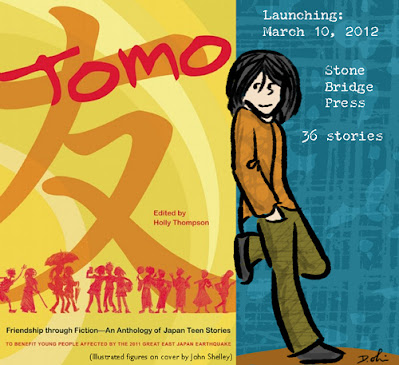
Launch card with Tomo cover with silhouettes by John Shelley and side illustration by Debbie Ridpath Ohi

In the first few weeks after the March 11, 2011 Great East Japan Earthquake and Tsunami, so many writers, illustrators and translators living in or connected to Japan wondered what they could do to help the tsunami- and nuclear disaster-ravaged communities of Tohoku in meaningful ways. I was just one of those individuals. And within a month of the tsunami I'd made two commitments that shifted my way of being in this world. 

One commitment was to join volunteer teams in cleanup efforts in Ishinomaki City in Miyagi Prefecture, which resulted in resets of my appreciation of disaster aid, community and the importance of being fully present in our daily lives and in interactions with others. 

The second commitment was to create an anthology of short fiction that would help support teens in Tohoku in the challenging years ahead. And thanks to the heroic efforts of so many talented and dedicated individuals, this commitment resulted in the Tomo Anthology: Friendship Through Fiction--An Anthology of Japan Teen Fiction published by Stone Bridge Press in March 2012. 

Compiling this anthology was a breathless volunteer sprint--36 stories to select, edit, finalize; over 40 contracts to be signed; cover design and illustrations to be finalized; reader's guide to be created; blog site to be built; interviews with contributors to be done; publicity plans to be made. The Tomo Anthology was completed on time thanks to the diligence of the more than forty contributing writers and translators; the generosity and patience of Stone Bridge Press publisher Peter Goodman; the hard work of the Stone Bridge Press editorial, design and publicity team; the intricate cover illustrations (can you match each silhouette to its story?) created by John Shelley; and all the other individuals working in the background to enable this anthology to be imagined, compiled, edited, printed and published in under one year.

While the Tomo Anthology is no longer in print, the Kindle E-book lives on--perfect for middle school and high school libraries and classrooms, reading groups, and gifts to friends. We hope you'll continue to support Tomo. All proceeds from the Tomo Anthology go to programs that support teens in 3/11 impacted Tohoku areas. 

Yesterday marked the eleventh anniversary of the Tohoku triple disaster, and people of the three hardest hit prefectures of Iwate, Miyagi and Fukushima and throughout Japan paused for a moment of silence at 2:46 p.m. We will not forget. 

Below, for this tenth anniversary of this anthology, we'd like to share some words from the publisher, editor, and some of the many creative contributors to Tomo: Friendship Through Fiction.

             Holly Thompson, Editor   


Peter Goodman, Publisher, Stone Bridge Press: As publisher of the Tomo anthology I am grateful to all the writers and translators and especially to Holly Thompson for entrusting us with the important mission of helping to create a bond among young adult readers in Japan and around the world. People who understand each other are inclined to help each other, and I’m sure the Tomo spirit will endure as many Japanese now step up to provide relief and compassion to others in distant lands.

Holly Thompson, Editor; author of foreword:  Growing this Tomo anthology with all the contributors and Stone Bridge Press has led to lasting friendships, and visits up and down the Tohoku coast. I continue to learn from those I meet in Tohoku--survivors, returnees, volunteers who stayed, newcomers and visitors. My hope is that Tomo will continue to encourage readers of all ages to take their own steps to support communities in need--those nearby, as well as those more distant.

Fumio Takano (高野史緒), author of "Anton and Kiyohime":  Over the past decade, not a day has gone by when I have not thought back on everyone's friendship. Not just the donations the book has generated, but the friendships, too, have been a real source of moral support. Thank you! I love you! 

Hart Larrabee, translator of "Anton and Kiyohime":  In summer 2012, I attended a translation workshop where participants, working with author Hideo Furukawa, collaboratively translated excerpts of his book about returning to his native Tohoku after 3/11. Regarding our rendering of one passage, he challenged us to “convey the essence of a tsunami through a sudden textual assault that leaves an uncanny tranquility in its wake.” The workshop changed the way I think about writing, and about the physicality of language. The essay I wrote about the workshop, the book, and 3/11 for the Society of Writers, Editors, and Translators can be found here on the SWET website.

Katrina Goldsaito, author of "I Hate Harajuku Girls": In these ten years since beloved Tomo, I’ve kept working with the subject of grief: publishing The Sound of Silence, set in Japan, which Maria Popova called "a serenade to the art of listening to your inner voice amid the noise of modern life"; a new book from Little, Brown on the Japanese concept of mono-no-aware; and our new global art experience ReachYou which offers mindfulness in grief. Happy 10th Anniversary, Tomo! What a project to be a part of.

Avery Fischer Udagawa, translator of "House of Trust" by Sachiko KashiwabaSince “House of Trust” appeared in Tomo, Iwate-born and -based author Sachiko Kashiwaba has continued to write spellbinding fiction for children and young adults, often with a touch of folklore, magic, or both. I had the honor of translating her novel Temple Alley Summer, inspired by an antique map of Morioka, for publication in the U.S. in 2021. Recently, her novel Misaki no mayoiga (The House of the Lost on the Cape), first serialized in the Iwate Nippō newspaper’s Nippō Junior Weekly and set in post-3.11 Tōno, has reached new audiences as an award-winning animated film.

Debbie Ridpath Ohi, author of "Kodama"I’ve become a fan of the Uncanny Japan podcast and only recently realized that Thersa Matsuura was a co-contributor to Tomo….what a wonderful coincidence!

Misa Dikengil, translator of "The Dragon and the Poet" by Kenji Miyazawa: Contributing to the Tomo Anthology was in many ways the beginning of my translation career and I am forever honored to be a contributor. The anthology brought together a wonderful group of writers and translators who all share a deep love for Japan. Personally, this project helped me feel like I could contribute in some way to the 3/11 recovery even from the other side of the planet and gave me an opportunity to translate a short story by Kenji Miyazawa, an author whose work greatly shaped how I viewed the natural world as a young adult. May Tomo continue to keep the events of 3/11 in the hearts and minds of all who read it.

Ann Tashi Slater , author of "Aftershocks":  My Tomo story "Aftershocks" was published in Scholastic's SCOPE magazine in February 2020. I'm thrilled that the story was introduced to a wide audience of educators and young readers and that they could learn more about the 3/11 disaster. 

Charles De Wolf (須田狼庵), author of  "Borne by the Wind":  I remember with admiration the response of the Japanese people and the world at large to the earthquake and tsunami of 2011. Even amidst ongoing disasters, caused by both Nature and human folly, one can still find inspiration. I feel most privileged to have been able to contribute to TOMO and to enjoy the work of so many talented writers. I often reach to take the volume off a bookshelf repaired after being shattered eleven years ago and, leafing through it, continue to hope that it will attract ever more readers, young and old.

Suzanne Kamata, author of "Peace on Earth"Recent world events have reminded us of the importance of reaching across borders and helping each other, as well as the solace and kinship that we can find through the written word. I am proud to have been a contributor to this effort through the Tomo Anthology, and I believe that the book’s themes remain as relevant now as they were ten years ago. On a personal level, I have been sustained by stories at the worst of times. The Tomo Anthology is an example of the best that we as writers and translators can do.

Margi Napper, author of "The Lost Property Office":  I’d like to say that I have been traveling in time like the hero of my story in “Tomo”….  Perhaps I have!  I’m back in England now, but I seem to have left a bit of myself in Tokyo. I saw a Shiba-inu yesterday and the owner said that people here didn’t recognize them. But I did and it took me from a path in Cornwall directly back to Tokyo. I was so delighted I spoke to the dog in Japanese. Probably didn’t understand me, but its presence made me wonderfully homesick for a brief moment.

Wendy Tokunaga, author of  "Love Right on the Yesterday":  Since “Tomo” means friend, it's fitting that I connected with many new writer friends by being in Tomo. A writing community is a powerful thing. And literature and friendship can make for a better world. Happy Anniversary!

Sako Ikegami, translator of "Hachiro" by Ryusuke Saito:  Ten years since Tomo publication and now I work at a psychiatric clinic amidst another far-reaching disaster. The pandemic-imposed isolation, drastic societal changes, and the loss of school life have hit teens hard. Kokoro no care (psychological care for the heart and soul) in PTSD, hesitantly introduced after the Great Hanshin Earthquake, was common sense by the aftermath of the Tohoku Earthquake. Then, mental health professionals gathered to care for long lines of people no longer ashamed to admit they were struggling. Today, thankfully, youths can access mental health clinics on their own—Japan’s health insurance services for minors makes it possible.

Deborah Iwabuchi, translator of “The Law of Gravity” by Yuko Katakawa:  In the years since I met her in person at the wonderful Tomo launch event, Yuko Katakawa has finished up veterinary school and is in practice with her husband in Ichinomiya, Aichi. She is still writing novels for young people as well as articles on raising pets. In 2015, my husband and I finally made a trip from Gunma to Miyagi to see with our own eyes what had happened four years previous. I especially wanted to see Onaya, a town we’d visited in 1981 with my parents. Back then we’d arrived on a train that ran up the water’s edge. We’d stayed in a minshuku inn run by a family who used to be whalers. Nothing remained of the coastline or the train. We had no way of knowing what had happened to these lovely people who had fed us seafood so fresh it was still moving on the plate, who handed their own toast and hot coffee to my parents who were struggling through a Japanese-style breakfast.

Louise George Kittaka, author of "Just Wan-derful":  The story I submitted to the Tomo Anthology (Just Wan-derful) was inspired by my own children. They are the same generation as the first readers of Tomo, along with the teenagers whose lives were disrupted by the 2011 Tohoku earthquake and tsunami. All these young people have now reached adulthood and are making their way in the world. As we look back on a decade since the publication of Tomo and Japan breathes in a brand new spring, I wish these resilient, empathetic young people a bright future, and I look forward to seeing their contributions to society.


Thursday, March 11, 2021

Ten Years After the March 11 Tsunami

On this spring day with clear skies throughout most of Japan, we mark the ten year anniversary of the March 11, 2011 Great East Japan Earthquake and Tsunami. 

Last month's 7.3 magnitude quake of the coast of Tohoku served as a temblor reminder of this ten-year mark, and an urgent message to all of us, everywhere: be disaster prepared. For those of us in coastal areas, the recent quake was also a powerful reminder should a tsunami siren ever sound to follow Tohoku survivor advice and run farther, run higher. 

Tomo: Friendship Through Fiction: An Anthology of Japan Teen Stories was generously published one year after 3/11 in 2012 by Stone Bridge Press as a benefit anthology to raise funds for teens in the 3/11 disaster affected areas. The anthology is still available as an e-Book (AmazonAmazon Japan). Please continue to purchase and share: the anthology includes 36 Japan-related stories, including ten in translation, grouped thematically. Proceeds support programs for teens in the tsunami affected areas of Tohoku as they continue to navigate the challenges of regional recovery and the individual and collective trauma in the region. Since 2020 proceeds were smaller than previous years, those funds are being held over until next year.

If you would like to know more about the March 11, 2011 earthquake and tsunami, NHK World has shared a number of videos related to the #311 disaster and recovery efforts throughout Tohoku. 

This is a difficult day for many. This morning, I began with a beach stroll alongside the sea. Later I will visit a quiet temple here in Kamakura and light incense. May you all have a way to find hope on this day that stirs up much pain. 

Here, I offer you the calming notes of survivor Teiichi Sato, author of The Seed of Hope in the Heart, playing Adagio by Tomaso Albinoni in his seed shop in Rikuzentakata in Iwate. 

May those we lost rest in peace. May those who survived find peace and light in the coming days. May we continue to support recovery from the March 11, 2011 earthquake and tsunami in its many forms. 


Wednesday, March 11, 2020

Tomo Anthology Supports Kesennuma NPO Sokoage

March 11, 2020 marks nine years since the 2011 Great East Japan Earthquake and eight years since the Stone Bridge Press publication of Tomo: Friendship Through Fiction--An Anthology of Japan Teen Stories. Port cities along the coast are still in the midst of massive reconstruction projects and neighborhood development and revitalization, and this past autumn brought harsh new challenges to recovering areas of Tohoku with damaging typhoons. Typhoon number 19 (Hagibis) in October caused devastating floods resulting in nearly 100 deaths in Tohoku--the majority in Fukushima Prefecture. The Tomo Anthology community helped to spread the call for volunteers to help with inundation clean-up efforts.


As recovery from the 2011 Great East Japan triple disasters and recent typhoons continues, proceeds from sales of the Tomo Anthology still assist programs for teens in Tohoku. In 2019, the Tomo Anthology donated 100,000 JPY to the certified NPO 底上げ Sokoage in the city of Kesennuma in the northeast Miyagi Prefecture.

In October, I traveled up to Tohoku to participate in post-typhoon volunteer flood clean-up work in Miyagi prefecture, and was able to visit Kesennuma to meet with Takafumi Narumiya, one of Sokoage's four staff members, in Pier 7's waterfront Square Ship co-working space.


Narumiya-san explained Sokoage's broad aims to provide opportunities for youth in the area, foster community, cultivate connections across generations, and support camps and programs for college students to engage with their Miyagi Prefecture communities from wherever they may be based.

The Sokoage Facebook page offers a glimpse at these programs and provides a sense of the spirit and dedication of the individuals at the heart of this NPO.

Your purchases of the Tomo Anthology which include 36 Japan stories for teens, including ten in translation, will help us continue to support teen programs in recovering areas of 3/11 impacted communities in Tohoku. Thank you!

May the Tohoku cities and towns hard hit by the 2011 triple disasters continue to utilize their resilience and determination to come together to create vibrant Tohoku communities for generations to come.


Holly Thompson, Editor, Tomo Anthology, March 11, 2020

Monday, December 31, 2018

2018 Tomo Year-end Donations

On this December 31, I'm happy to report that Tomo: Friendship Through Fiction--An Anthology of Japan Teen Stories published in 2011 by Stone Bridge Press continues to raise funds for teens in Tohoku areas affected by the 2011 earthquake and tsunami. Nearly seven years after publication, funds are still generated by this anthology that I compiled and edited in the months soon after the disaster. 

This month Tomo's publisher Peter Goodman of Stone Bridge Press made a donation of $683.09 USD (76,770 JPY) to the NPO TEDIC
www.TEDIC.jp
Based in Ishinomaki in Miyagi Prefecture, TEDIC provides support and counseling for youth, including those struggling with poverty, neglect, abuse, disability, truancy, illness, and social withdrawal. 

And today I made a donation of 100,000 JPY ($905.00 USD) to the NPO Sokoage ソコアゲ (to which Tomo funds were also donated in 2017). You can donate via their website or via this Yahoo! Japan Sokoage Fundraiser


www.facebook.com/sokoageJAPAN/
Sokoage (底上げ means "raising up") is based in Kesennuma, also in Miyagi Prefecture. This NPO engages high school students in community building and problem solving by encouraging them to take initiative to become changemakers and by supporting their projects to create a vibrant society. Projects have included the creation of a gathering space near the high school for students and Sokoage staff members; holding monthly community meal events with guest speakers; guiding students in getting to know their community, as well as creating materials to promote the region and record experiences of 3/11; providing volunteer academic support in temporary housing sites and elsewhere; encouraging students who have graduated from high school to stay involved in Kesennuma issues and events; and holding supportive training camps for college students.

I wish everyone sweet hatsuyume dreams of eggplants, hawks and Mt. Fuji (all considered auspicious if sighted in dreams on January 1) and hope that the New Year brings peace and joy and the promise of bright futures to young people throughout the Tohoku region.  

Holly Thompson


Saturday, June 6, 2015

Tomo Still Giving

All proceeeds from sales of the book Tomo: Friendship Through Fiction--An Anthology of Japan Teen Stories are donated to support teens in the 3/11 tsunami- and earthquake-affected areas of Tohoku. 

Recently another 20,000 yen was donated to the Japanese NPO Hope for Tomorrow, which is providing educational support grants to high school students in the three hardest hit prefectures of Fukushima, Miyagi, and Iwate. 

source: Wikimedia commons

In 2014, educational support grants went to 127 students in the following schools:
  • Fukushima Prefectural Haramachi High School (Minami Soma City)
  • Miyagi-ken Ishinomaki High School (Ishinomaki City)
  • Miyagi-ken Kesennuma High School (Kesennuma City)
  • Iwate Prefectural Ofunato High School (Ofunato City)
  • Iwate Prefectural Takata Senior High School (Rikuzentakata City; temporarily located in Ofunato City)

Thank you to our publisher, Stone Bridge Press, and to everyone who continues to purchase copies of Tomo either in print or as an ebook. Your purchase does make a difference to teens in Tohoku. 

We hope that the stories in Tomo offer windows and mirrors to our many readers. 

Wednesday, March 11, 2015

In the Wake of 3/11

Today, March 11, 2015, marks the four-year anniversary of 3/11, the date of the massive earthquake and tsunami that caused tremendous devastation in northern Japan, particularly in Tohoku. There is still much struggle and hardship in the region, and Tomo has continued to support teens in Tohoku through the NPO Hope for Tomorrow


Ishinomaki, May 4, 2011 (photo by Holly Thompson)

Have you read the 36 stories in the Tomo: Friendship Through Fiction anthology? On this Tomo Anthology blog is an extensive Readers' Guide to the anthology, as well as many, in-depth interviews featuring author and translator contributors.

Below are some articles that may be of interest on this fourth anniversary, two of them by Louise George Kittaka, a Tomo anthology contributing author:


And below is a free webinar to be held on April 15 by the National Consortium for Teaching about Asia featuring works in two concurrent exhibits at the Museum of Fine Arts Boston: 

The Great Wave of Hokusai and the Great Wave of 3/11: Japanese Artists' Responses to Nature

Wishing all in Tohoku love and wellness--from the Tomo Anthology community of authors, translators, illustrators and the generous publisher Peter Goodman of Stone Bridge Press

Wednesday, March 26, 2014

Three Years After, Tomo Keeps Giving

March 11, 2014 marked the three-year anniversary of the Great East Japan Earthquake and Tsunami.

Recently the 2013 earnings from sales of Tomo: Friendship Through Fiction plus the Stone Bridge Press publisher donation--a total of 50,000 yen--was transferred to the Japan-based NPO Hope for Tomorrow.


Hope for Tomorrow continues to provide meaningful much-needed support to teens in the quake and tsunami affected areas of Tohoku in northern Japan.

Your purchase of Tomo: Friendship Through Fiction--An Anthology of Japan Teen Stories really does make a difference to teens in Tohoku. Consider donating a copy of Tomo to your school or town library, suggesting it to book groups, and purchasing copies as gifts.

See Hope for Tomorrow's website to learn about this small NPO with a big heart and their commitment to longterm education-focused aid for young people in Tohoku.

Sunday, December 2, 2012

Giving through Tomo: Friendship Through Fiction--2012 Donation to Hope for Tomorrow

Tomo: Friendship Through Fiction--An Anthology of Japan Teen Stories is a benefit anthology of young adult fiction, and it is a pleasure to announce the first donation resulting from the sales of this collection of Japan-related stories. As explained in previous Tomo Blog posts (here and here) the first donations from the sales of Tomo: Friendship Through Fiction will go to Hope for Tomorrow (hope-tomorrow.jp), the Japan-based NPO that provides three methods of support (Educational Support Program, the International Exchange Support Program, and the Foreign Language Support Program) to high school students in areas of Tohoku hardest hit by the major tsunami and earthquake of 2011.

A donation of 100,000 yen (at the current exchange rate about 1,200 USD) was made today to Hope for Tomorrow. This money includes royalty earnings for the first half of 2012 (Tomo was published in March 2012) plus Stone Bridge Press publisher donations for that same period (rounded up with an additional 727 yen from the editor for a total of 75,000 yen), as well as editor's advance money (25,000 yen). Note that the editor's advance has otherwise only been used for printing Tomo publicity postcards, and a small amount has been set aside to enable more cards to be printed.

A huge thank you to all the Tomo authors and translators for donating their stories and their time. Also thanks to Peter Goodman at Stone Bridge Press for the generous publisher donations and for making this project possible. And thank you to Hope for Tomorrow, for providing much needed long-term support for teens in Tohoku.

Please continue to support this project--tell your friends about Tomo: Friendship Through Fiction. Tell teachers and librarians about the Tomo Reader's Guide, which is full of discussion questions and writing activities, and remind them about the extensive cache of author, illustrator and translator interviews on the Tomo Blog. And consider purchasing copies of Tomo: Friendship Through Fiction as holiday gifts--order through your local bookseller, your favorite online bookseller, or through Stone Bridge Press.


The teens in Tohoku need our long-term encouragement and support. 

Friday, June 29, 2012

Tomo--Distributors in the U.S. and Abroad

Tomo was recently on display at the huge ALA (American Library Association) annual conference in Anaheim--in the booth for Consortium Book sales and Distribution. Consortium is the distributor for Tomo's publisher Stone Bridge Press.

Besides online booksellers, for distribution outside the U.S., check out the contacts on the Stone Bridge Press Distribution page, which includes info for distributors in Japan and Korea, as well as other parts of Asia.

Sunday, October 2, 2011

Announcing the Tomo Cover

Yesterday, within 24 hours of the deadline, I handed in the complete manuscript for the Tomo anthology. Included are 36 stories, including 10 in translation. What an amazing feat of cooperation between authors, translators, illustrators, editor, publisher, and everyone at Stone Bridge Press! Thank you to all of the generous and heroic contributors for making this possible. You have been an amazing team, and I cannot wait to share this book with the world.

And now, in a great coincidence of timing, I'm thrilled to reveal the Tomo cover. The official title is Tomo: Friendship Through Fiction--An Anthology of Japan Teen Stories. The Tomo cover features a bold and sweeping calligraphic 友 (tomo) which is the Japanese kanji character for friendship. Along the lower edge of the cover, wrapping around to the back, are figure sketches by the incredible John Shelley, an illustrator who has spent many years in Japan and is currently based in London. Authors may just recognize a few of their story characters!

So tell your friends, and help us get the word out about Tomo! Publication date is March 10, 2012.

Saturday, June 18, 2011

Introducing Tomo--a YA Anthology of Japan-related Fiction

-->
I'm  so happy to announce that Tomo 友, a young adult anthology of fiction set in or related to Japan, will be published by Stone Bridge Press in Spring 2012. Since the devastating earthquake and tsunami of March 11, I have been eager to find a way for Japan-connected fiction to raise funds specifically for teens in the hard-hit areas of Tohoku. Stone Bridge Press, with its focus on books about Asia and Japan, is a perfect fit for this project. Tomo will enable teens and adults worldwide to contribute to long-term relief efforts for teens in quake- and tsunami-affected Tohoku, while immersing themselves in short stories set in and related to Japan. Please read about this new YA anthology project and help us announce the call for submissions by tweeting and posting on your blogs and Facebook pages. 

This Tomo blog will include news about the anthology, contributor interviews, information about the organizations, locations and teens that Tomo will support, and much more. Please follow this blog and share the link.

So please join me in celebrating--with some Tohoku sake? Tohoku kamaboko? Tohoku wakame? Tohoku rice? You choose!

Holly Thompson, Editor of Tomo 友

*************************************************************
Tomo 友—YA Anthology of Fiction

Tomo (written友, meaning “friend” in Japanese) is a forthcoming benefit anthology of short fiction set in or related to Japan for readers ages 12 and up. Tomo will be edited by Holly Thompson and published in print and digital formats by Stone Bridge Press in Spring 2012.  Proceeds from the sale of Tomo will support teens affected by the Great East Japan Earthquake of March 11, 2011.

Tomo will feature original short fiction in English by authors with a significant connection to Japan by heritage or experience, as well as short fiction in translation (Japanese to English) by Japanese authors.

Submit by August 15, 2011. 

Tomo seeks short fiction up to 5,000 words (up to 3,000 words preferred) set in or strongly related to Japan for readers age 12 and up, either original stories in English or stories translated from Japanese. In addition to standard prose fiction, submissions of fiction in verse, flash fiction, and comics (black and white) will also be considered.

Tomo aims to enable teens and adults worldwide to contribute to long-term relief efforts in Japan while exposing them to Japan through YA short fiction.

Contributors will not be paid. Proceeds from the sale of the book will support teens affected by the Great East Japan Earthquake of March 11, 2011. 

Submission Guidelines

1.     Stories submitted must be short fiction set in Japan or strongly related to Japan written by authors connected to Japan by experience or heritage.
2.     Stories must be original stories in English or stories translated from Japanese into English. No translations will be accepted without written permission from the original author or rights holder.
3.     Stories of 3,000 words or less are preferred. Longer submissions, up to 5,000 words, will also be considered. Excerpts will be considered only if they work as stand-alone stories.
4.     Stories must be young adult (YA) fiction with a protagonist aged 13 to 17.
5.     Stories that reflect contemporary Japan are preferred. Stories in in any style or genre (historical, fantasy, paranormal, manga, experimental, etc.) will be considered.
6.     Like the best YA stories, submissions should have a unique and powerful voice; be an emotional/funny/surprising/moving read; be fast paced, not be bogged down with description; and be exquisitely crafted.
7.     Contributors will not be paid. Each contributor will receive two copies of Tomo.

Permissions Guidelines

1.     If you are the original author, with your submission you only need state that you are the author, that the story is original, and that you are able to give permission for its use in Tomo. If your story is selected you will be asked to sign an agreement that will give the publisher of Tomo the right to publish your story in print and digital formats.
2.     If you are the translator, in addition to giving permission to use your work you will need to obtain a letter from the original author or current rights holder that (1) grants you the right to translate the work into English and (2) grants the publisher of Tomo the right to publish the translation in print and digital formats.

Submission Instructions

1.     Submit by sending your story as an email attachment in Word or Word-readable (e.g., rtf) format to tomoanthology (at) gmail (dot) com by August 15, 2011. For illustrated works use jpeg or pdf format. Query for guidelines if the size of your file submission exceeds 10 MB.
2.     In the email subject line write your last name, your first name, title of story (e.g. Thompson, Holly, Mikan Wars)
3.     In the body of the email, above the story, include the following information in this order (for translations include the information for both author and translator):

      Name
      Bio (up to 50 words) and website or blog URL
      One-sentence statement explaining author’s (or translator’s) connection to Japan (up to 30 words)
      Word count
      Contact information name, e-mail, address, phone
      Permission/rights status (for translations)

Queries

For queries, email tomoanthology (at) gmail (dot) com with the word Query in the subject line.